


Hey there! As a supplier of sewage trucks, I often get asked about the shock - absorbing systems in these vehicles. You know, sewage trucks are no ordinary trucks. They have to deal with all sorts of rough terrains and heavy loads while transporting sewage from one place to another. That's where shock - absorbing systems come in super handy.
First off, let's talk about why shock - absorbing systems are so important in sewage trucks. Sewage trucks are usually pretty heavy because of the sewage they carry. When they're on the road, especially on bumpy or uneven surfaces, the constant jolts and vibrations can cause a lot of problems. Without proper shock absorption, the truck's components can wear out quickly. Things like the engine, the transmission, and even the sewage tank itself can be damaged. Plus, a rough ride can make it difficult for the driver to control the vehicle, which is a big safety risk.
One of the most common shock - absorbing systems in sewage trucks is the leaf spring suspension. Leaf springs are basically long, flat pieces of metal that are stacked on top of each other. They're attached to the truck's frame and the axles. When the truck hits a bump, the leaf springs flex and absorb the shock. This helps to keep the truck stable and reduces the amount of vibration that gets transferred to the rest of the vehicle.
Leaf spring suspensions are great because they're simple and reliable. They've been used in trucks for a long time, and over the years, they've been improved to be more effective. They can handle heavy loads pretty well, which is perfect for sewage trucks. However, they do have some drawbacks. For example, they can be a bit stiff, which means the ride might not be as smooth as you'd like. And over time, the leaf springs can wear out and need to be replaced.

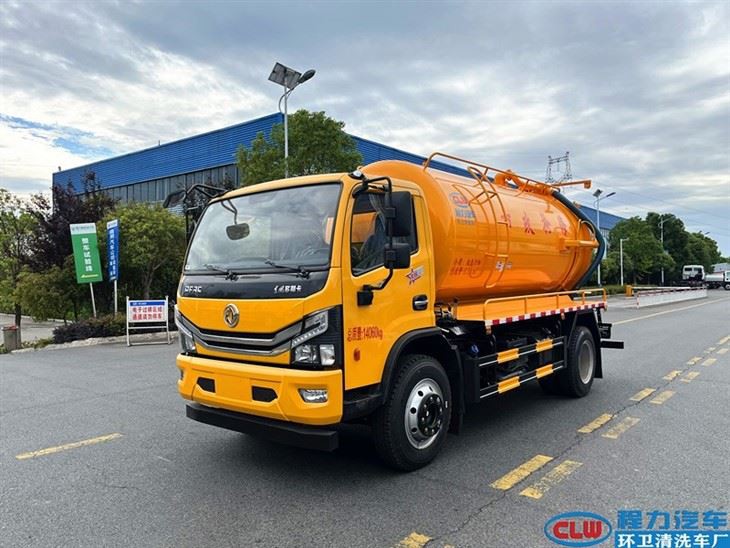
Another popular shock - absorbing system is the coil spring suspension. Coil springs are made of a coiled piece of metal. They work in a similar way to leaf springs, but they're more flexible. When the truck goes over a bump, the coil springs compress and then expand, absorbing the shock.
Coil spring suspensions offer a smoother ride compared to leaf spring suspensions. They can better adapt to different road conditions and provide more comfort for the driver. They also take up less space, which can be an advantage in a sewage truck where space is often limited. But coil springs are generally more expensive than leaf springs, and they might not be as strong when it comes to handling extremely heavy loads.
Then there are the shock absorbers themselves. Shock absorbers are like the unsung heroes of the shock - absorbing system. They're usually paired with either leaf springs or coil springs. Their main job is to control the movement of the springs. When a spring compresses or expands, the shock absorber slows down that movement, preventing the truck from bouncing up and down too much.
There are different types of shock absorbers. One common type is the hydraulic shock absorber. It uses a fluid to dampen the movement of the springs. When the spring moves, the fluid is forced through small holes in the shock absorber, creating resistance and slowing down the movement.
Another type is the gas - charged shock absorber. These shock absorbers use a gas, usually nitrogen, to provide additional damping. Gas - charged shock absorbers are known for their better performance and longer lifespan compared to hydraulic shock absorbers. They can also handle high - speed bumps and rough roads more effectively.
In addition to these traditional shock - absorbing systems, some modern sewage trucks are starting to use air suspension systems. Air suspension uses air bags instead of springs. These air bags are filled with compressed air, and they can be adjusted to change the height and stiffness of the suspension.
Air suspension offers a lot of benefits. It provides an extremely smooth ride, no matter what the road conditions are. The driver can adjust the suspension settings depending on the load and the type of terrain. For example, if the truck is carrying a heavy load, the driver can increase the air pressure in the air bags to make the suspension stiffer. And when the truck is on a smooth road, the driver can reduce the air pressure for a more comfortable ride.
However, air suspension systems are more complex and expensive than traditional suspension systems. They also require more maintenance. But for those who want the best in terms of ride quality and adjustability, air suspension is definitely worth considering.
Now, if you're in the market for a sewage truck, you might be wondering which shock - absorbing system is the best for you. Well, it really depends on your specific needs. If you're on a tight budget and need a reliable system that can handle heavy loads, leaf spring suspension might be the way to go. If you want a smoother ride and are willing to spend a bit more, coil spring suspension or air suspension could be better options.
At our company, we offer a wide range of sewage trucks with different shock - absorbing systems. We understand that every customer has different requirements, and we're here to help you find the perfect truck for your needs. Whether you're a small - scale sewage disposal company or a large - scale municipality, we've got you covered.
If you're interested in learning more about our Sewage Vacuum Truck, just reach out to us. We'd be more than happy to have a chat with you about the shock - absorbing systems and other features of our trucks. We can also provide you with a detailed quote and answer any questions you might have.
In conclusion, shock - absorbing systems play a crucial role in the performance and safety of sewage trucks. By choosing the right system, you can ensure a smooth ride, reduce wear and tear on the truck, and improve the overall efficiency of your sewage disposal operations. So, don't hesitate to contact us if you're thinking about purchasing a sewage truck. We're looking forward to working with you!
References
- Automotive Suspension Handbook: Fundamentals, Theory and Design by Hans - Jürgen Bäcker
- Vehicle Dynamics: Theory and Application by R. Rajamani


